

Engineering at the Edge of the World: A Dialogue between Algeria and Cape Verde at ASET 18 May 2026
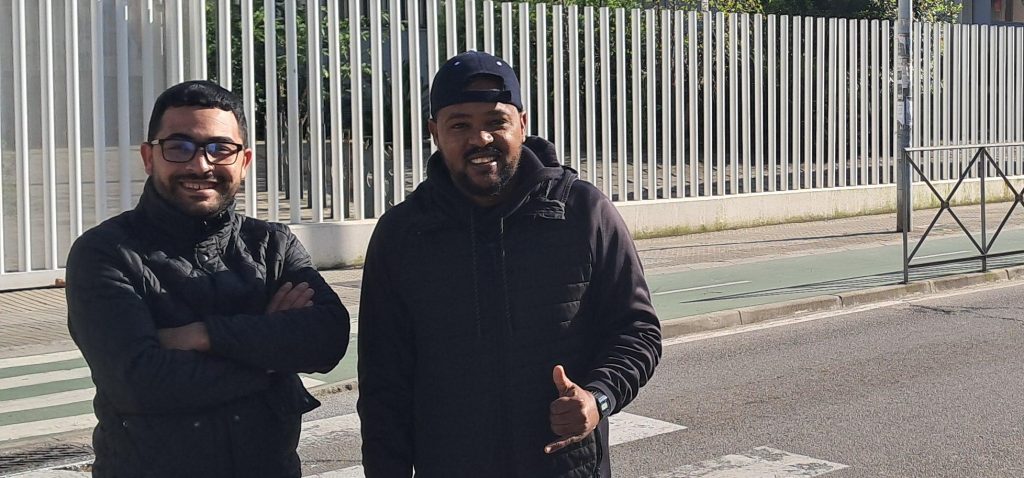
Mohammed Yassine Mazari and Rudson Roger Pires Lopes cross paths in the classrooms of the School of Algeciras as Erasmus students. One returned, drawn by cutting-edge research; the other arrived by a stroke of luck that he celebrates today. Both are discovering that, in the Campo de Gibraltar, engineering theory comes to life in the laboratories and in a unique industrial environment.
Algeciras, May 6, 2026.
There are encounters that can only happen at communication hubs. Mohammed, an Algerian PhD student, and Rudson, a Cape Verdean student, represent the vibrant university spirit promoted by the University of Cadiz. Through their answers, we reconstruct an engineering map that knows no borders, but rather precise technical processes and human hospitality.
The Strait as a meeting place
For Mohammed, Algeciras was a reunion. After a brief stay in 2024 with Professor David Sales Lérida, he knew he had to return: “I was motivated by the atmosphere and the possibility of diving deeper into my experiments; when the Erasmus opportunity arose, I didn’t hesitate.” Rudson, on the other hand, defines his arrival as a “stroke of luck.” Having no prior knowledge of the city, today he firmly states that, if he could travel back in time, he would consciously choose Algeciras.
Both agree that the welcoming atmosphere has been the first crucial gear of their stay. Mohammed highlights his integration into the Smart Manufacturing Lab of the UCA·SEA innovation center and the support from people like Fernando (de la Iglesia), an international relations intern at the Campus. Rudson goes further, speaking of a necessary fairness when describing the “friendliness and promptness” of all the staff, both teaching and non-teaching, in helping him achieve full integration.
Where theory becomes practice
The technical dialogue emerges when comparing their home universities with ASET (Algeciras School of Engineering and Technology). Rudson observes that, although globalization has standardized the theoretical basis of Mechanical Engineering, the difference lies in the execution: “The conditions for practical classes and laboratories here are, without a doubt, infinitely better.” He has been surprised by the library and its soundproof rooms, a perfect refuge for group study.
Mohammed, focused on his PhD research, values the connection between theoretical concepts and the real-world applications of the materials he studies. For him, the bond with the center’s research groups is the key to achieving significant results and future scientific publications.
A landscape for ingenuity
The School’s location, embraced by two natural parks and a top-tier industrial hub, is no minor detail. For Rudson, it is a “perfect fit” that facilitates direct contact with companies in various sectors. Mohammed, a sea lover, finds the surrounding landscapes a great stimulus to live and study. Furthermore, as a Muslim, he highlights the local respect and cultural compatibility, making the region a “comfortable and welcoming” place.
At the end of the day, both send a message to those in their home countries who might hesitate to cross the sea to UCA. “It is an opportunity to grow academically and personally,” says Mohammed, reminding us that language is not a barrier when there is a will; “While I learn Spanish, I can communicate in English, and in Algeciras, many people speak Arabic.” Rudson concludes: “Make the most of it; it’s an excellent place with a remarkably high quality of teaching.”
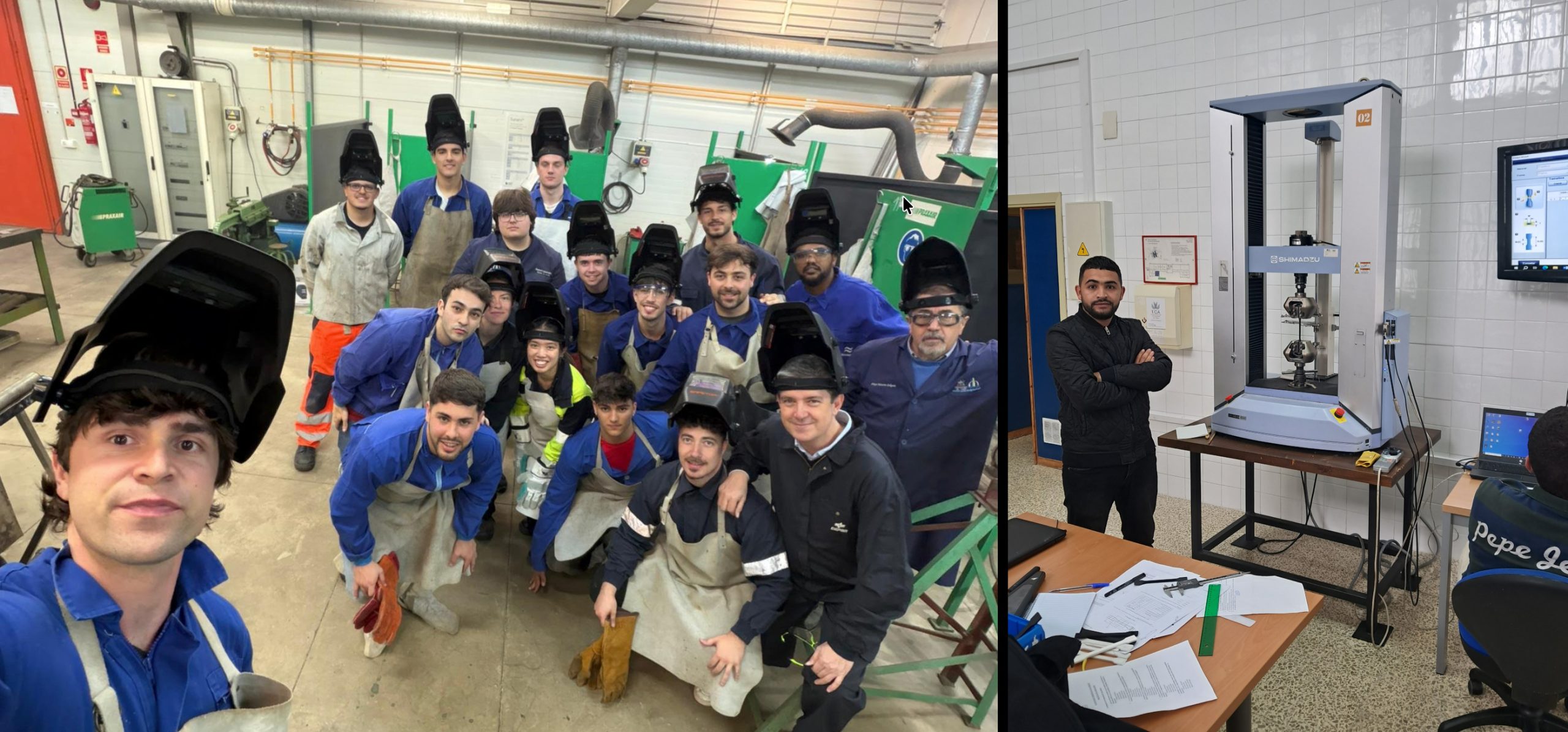
On the left, Rudson Lopes alongside his Mechanical Engineering classmates in the ASET welding workshop. On the right, Mohammed Mazari in the ASET Materials Science laboratory.